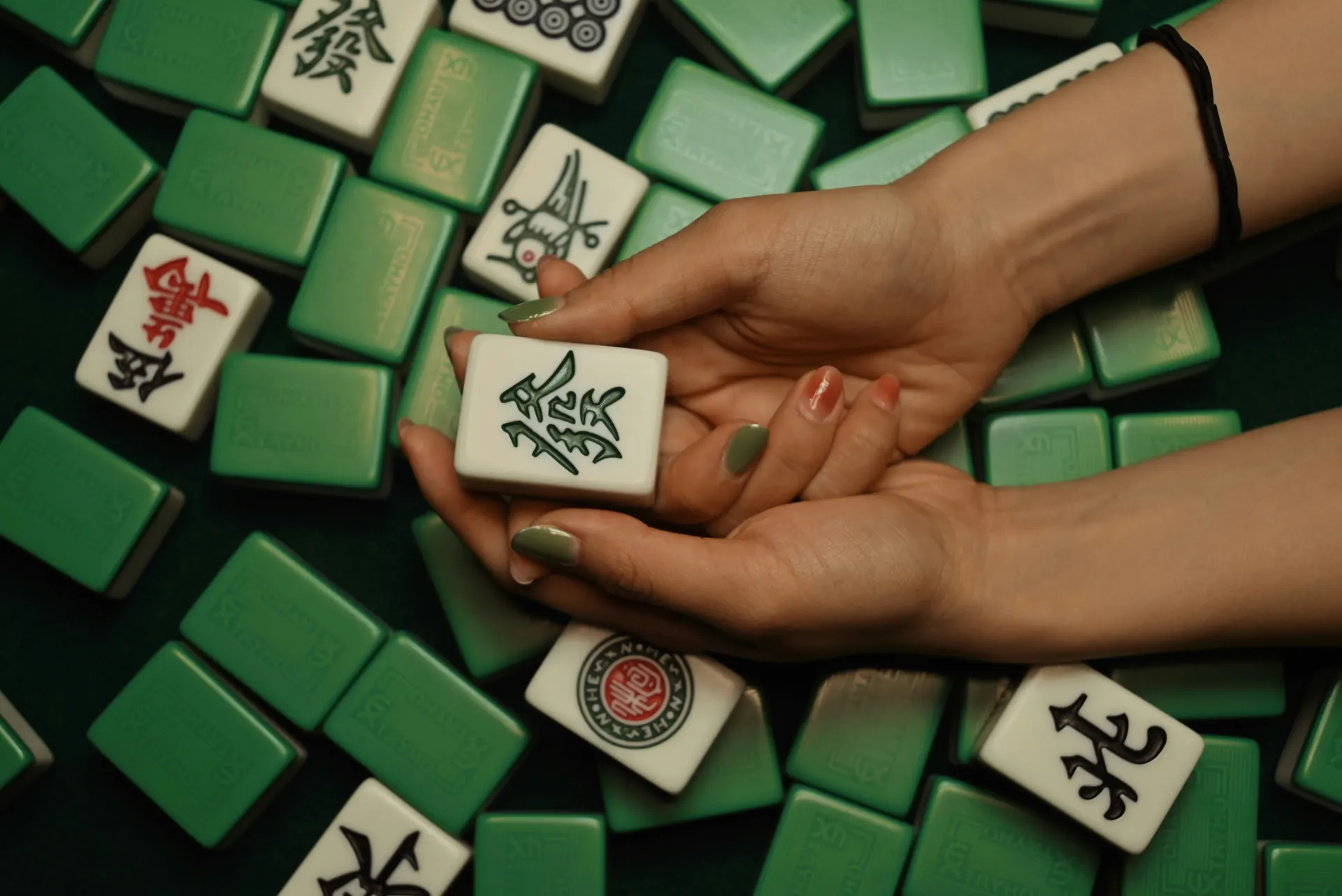
American Mahjong Tile Sizes Explained
What the three tile measurements actually mean, why thickness decides whether a tile fits your rack, and which size suits the players at your table.
Almost every question about buying an American Mahjong set comes down to one thing: size. Not the number of tiles — that is fixed at 166 — but the physical dimensions of each one. And when suppliers list sizes, they usually throw three numbers at you with no explanation of which of them you should actually care about.
Here is what those numbers mean and how to choose.
The three measurements, in plain terms
A tile is listed as width × height × depth.
- Width and height are the face of the tile — the surface with the engraved character on it. This is the part that decides how easy the set is to read.
- Depth is how thick the tile is, front face to back. This is the part almost nobody mentions, and it is the one that causes problems.
A standard American tile is around 30 × 23 × 13 mm (about 1.18 × 0.91 × 0.51 inches). In practice, sizes cluster into three groups:
| Profile | Typical size | Common material | Set weight |
|---|---|---|---|
| Standard | 30 × 23 × 13 mm | High-density melamine | ~4.2–4.3 kg |
| Large | 32 × 24 × 14 mm | Solid acrylic | ~5.5 kg |
| Extra large | 33 × 25 × 15 mm | Multi-layer acrylic | ~6.2 kg |
Why depth matters more than people expect
Two millimetres of thickness sounds like nothing. In the hand, it is nothing. In a rack, it is everything.
Racks are milled to a tolerance. If you put a 15 mm tile in a rack cut for 13 mm, it will not seat — it stands proud of the rail and the whole row feels unstable. Put a 13 mm tile in a 15 mm slot and it leans back, so your hand is never quite square to the table and you keep nudging tiles back into place.
The professional term: this is a rack and tile match. In wholesale it is the single most common way an order goes wrong, because buyers choose a tile and a rack separately from two different suppliers who never speak to each other.
If you are buying tiles and racks together, buy them from the same place, or measure the rack slot first and choose the tile to match. This one step prevents more returns than anything else in this category.
Material: what melamine and acrylic actually feel like
Suppliers describe tiles as melamine or acrylic, which tells you very little if you are not a plastics engineer. Practically:
- High-density melamine is the workhorse. It is hard, it resists scratching, and it makes a crisp click when tiles meet. Most American sets are melamine, including our standard profile.
- Solid acrylic is denser and heavier, with a slightly warmer feel in the hand. It is what you find in sets aimed at players who sit down several nights a week.
- Multi-layer acrylic is how you get a tortoise-shell or other patterned tile. The pattern runs through the layers rather than being printed on top, which is why it has depth rather than looking like a sticker.
The word to look for alongside the material is colour-filled engraving. That means the symbol is cut into the tile and filled with colour, so it survives years of shuffling. Cheaper sets print the symbol on the surface, and the printing wears off — usually starting on the tiles used most, so the set fails unevenly.
Which size for which players
There is no universally best size. It depends entirely on who is playing.
- Clubs and leagues generally standardise on the standard 30 mm profile, because mixed equipment across a room causes arguments.
- Senior communities usually prefer 32 mm and up. The larger face is meaningfully easier to read without leaning in, which matters over a long session.
- Travel and casual home sets go smaller than 30 mm. If you are stocking for travel, note that smaller tiles will not fit a standard rack.
- Gift buyers tend to choose on look and colourway rather than dimensions, and that is fine — as long as the tile count is correct, every size plays the same game.
How to check a set you already have
If you are trying to match a set you own, do not trust the listing you bought it from. Measure it:
- Measure the tile face left to right for width, top to bottom for height.
- Stand a tile on its edge and measure front to back for depth.
- Measure three or four tiles, not one. Within a single batch, individual tiles vary slightly by design.
- Measure the rack slot too, if you have one. That is the number that decides what will actually fit.
Write those numbers down before you order anything. It takes two minutes and it is the difference between a reorder that matches and one that does not.
The number that never changes
Whatever size you choose, the tile count does not move: 166 tiles, including 8 Jokers, plus spare blanks. That configuration is what the National Mah Jongg League card is built around, and it is the same at 30 mm as it is at 33 mm. Size affects how the set feels. It does not affect how the set plays.
Tile Sizing Questions
What is the standard size of an American Mahjong tile?
Around 30 × 23 × 13 mm, which is roughly 1.18 × 0.91 × 0.51 inches. That is the size most American sets have used for decades, and it is what the majority of racks and table mats are built to hold. Larger sets run to 32 or 33 mm wide.
Does a bigger tile make the game easier to play?
The markings are larger, so a bigger tile is genuinely easier to read across a table — which is why senior communities tend to prefer 32 mm and up. What it does not do is change the rules or the number of tiles. A 33 mm set is still 166 tiles with 8 Jokers.
Why does tile thickness matter if it is only a millimetre or two?
Because the rack is cut to fit it. A rack milled for a 13 mm tile will not hold a 15 mm tile standing up, and a rack cut for 15 mm lets a 13 mm tile lean. Two millimetres is the difference between a rack that holds your hand steady all evening and one that keeps dropping tiles.
How do I measure a set I already own?
Measure one tile across its face for width and height, then measure the depth of the tile standing on its edge. Use a ruler with millimetre markings, and measure three or four tiles rather than one — manufacturing tolerance means individual tiles can vary slightly within a batch.
Are heavier sets better quality?
Not automatically. Weight tracks tile size and material density, so a heavier set is usually a bigger or denser tile rather than a better-made one. A well-finished 4.2 kg melamine set can feel better in the hand than a poorly finished 6 kg one.
Questions about your own table?
We make American Mahjong sets factory-direct and quote single sets as readily as full cartons. No order is too small to ask about.